
Concrete
Sampled fresh at placement: slump, air content, temperature, unit weight, and cylinders for strength. Broken at the specified ages.
Sampling and laboratory testing to the governing method. Every sample is tracked from where it is taken to the report it appears on.
Special inspection verifies work as it's built. Materials testing verifies what it's built from, using samples taken from that same work.
Most projects need both, and the two records are meant to reconcile.
Every sample is logged at the point it's taken and tested to the method the specification calls for.
Traceable back to the exact location and date it came from, not a number floating free of the project.
Every test is performed to an ASTM or AASHTO standard defining the procedure and the calculation.
Naming it on the report lets a reviewer check the procedure instead of taking the number on trust.
Samples are taken at the point of placement, logged with the location and date they came from, and handled under the conditions the method requires. A concrete cylinder that isn't cured correctly produces a number that means nothing, however precisely it's later broken.
In the laboratory, each sample is tested to the method the specification calls for, and the result is reported against the standard that produced it, tied back to where and when the sample was taken. The lab result and the field record are meant to reconcile, not arrive as two disconnected numbers.
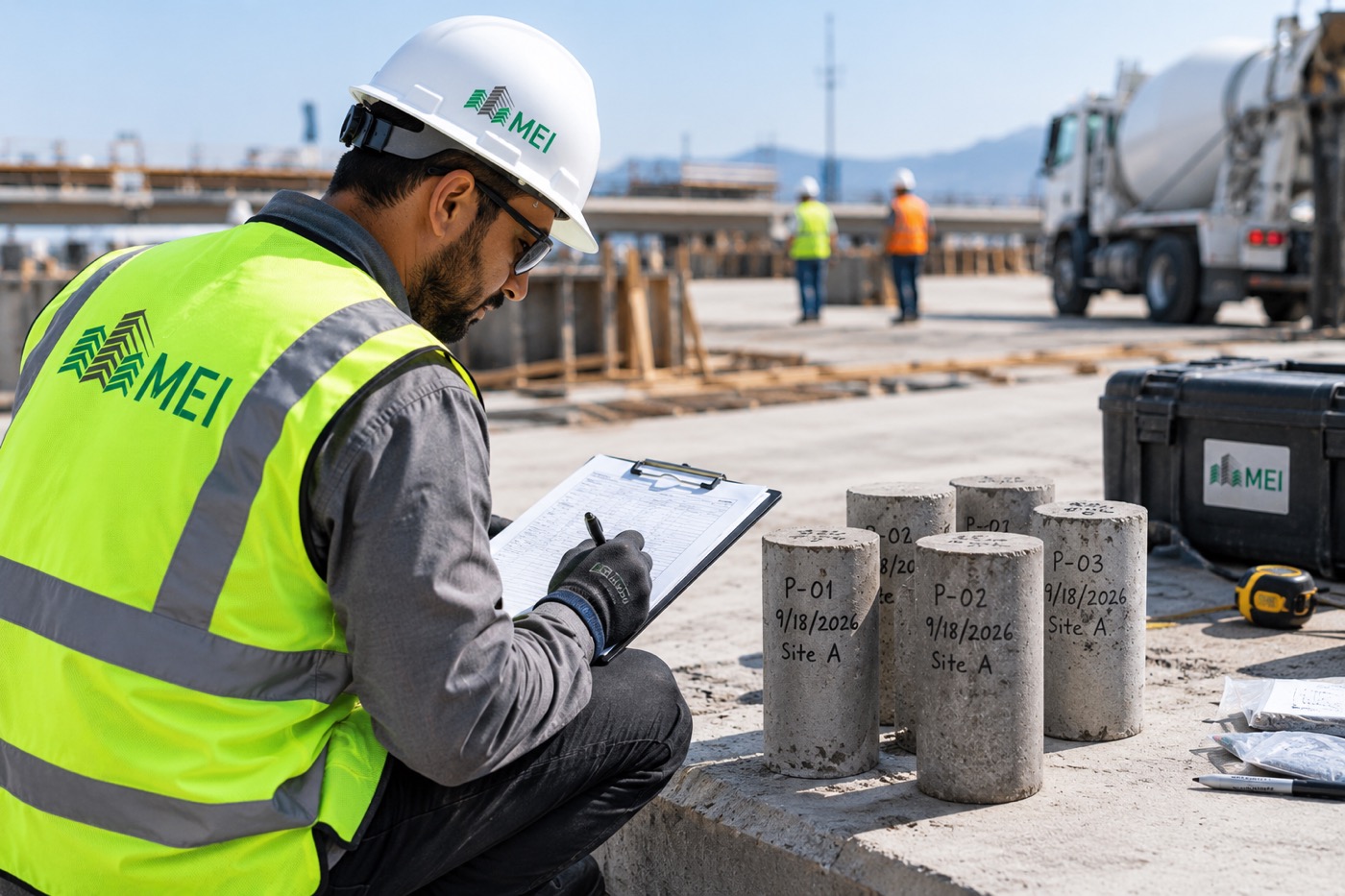
Sampled in the field or taken from the plant, then tested in the laboratory to the method the specification calls for.
Sampled fresh at placement: slump, air content, temperature, unit weight, and cylinders for strength. Broken at the specified ages.
Gradation, plasticity, moisture-density relationship, shear strength and expansion potential for site soils and import fill. Sets the reference for field compaction.
Binder content and gradation by extraction, specific gravity, and stability on plant-produced mix. Cores confirm in-place density against the job mix formula.
Gradation, specific gravity, absorption, abrasion, soundness and sand equivalent on base rock. Qualifies a source and confirms consistency.
Compressive strength of prisms, grout and mortar, plus sampling and absorption testing of units. Prism strength verifies the specified f′m.
Tensile, yield, elongation and bend testing of reinforcing bar, steel, welded and qualification coupons. Confirms mill certification.
Thickness, density, bond strength and cohesion of fire-resistive materials sampled from the installed work. Compared against the listed assembly.
In-place density and moisture of soil, aggregate base and asphalt, by nuclear moisture-density gauge. Operated under the licence the gauge requires.
Every test is run to a published ASTM or AASHTO method, named on the report so a reviewer can check the procedure instead of taking the number on trust.
The current drawing set and the relevant specification sections, including the mix designs or material requirements to test against.
Which materials, and at what stage: sampled at placement, taken from the plant, or cored from the installed work.
The site address, and where samples should be picked up or delivered from.
Approximate start date and duration, so technicians can be scheduled against your programme.
Request a quote and we'll get back to you.